
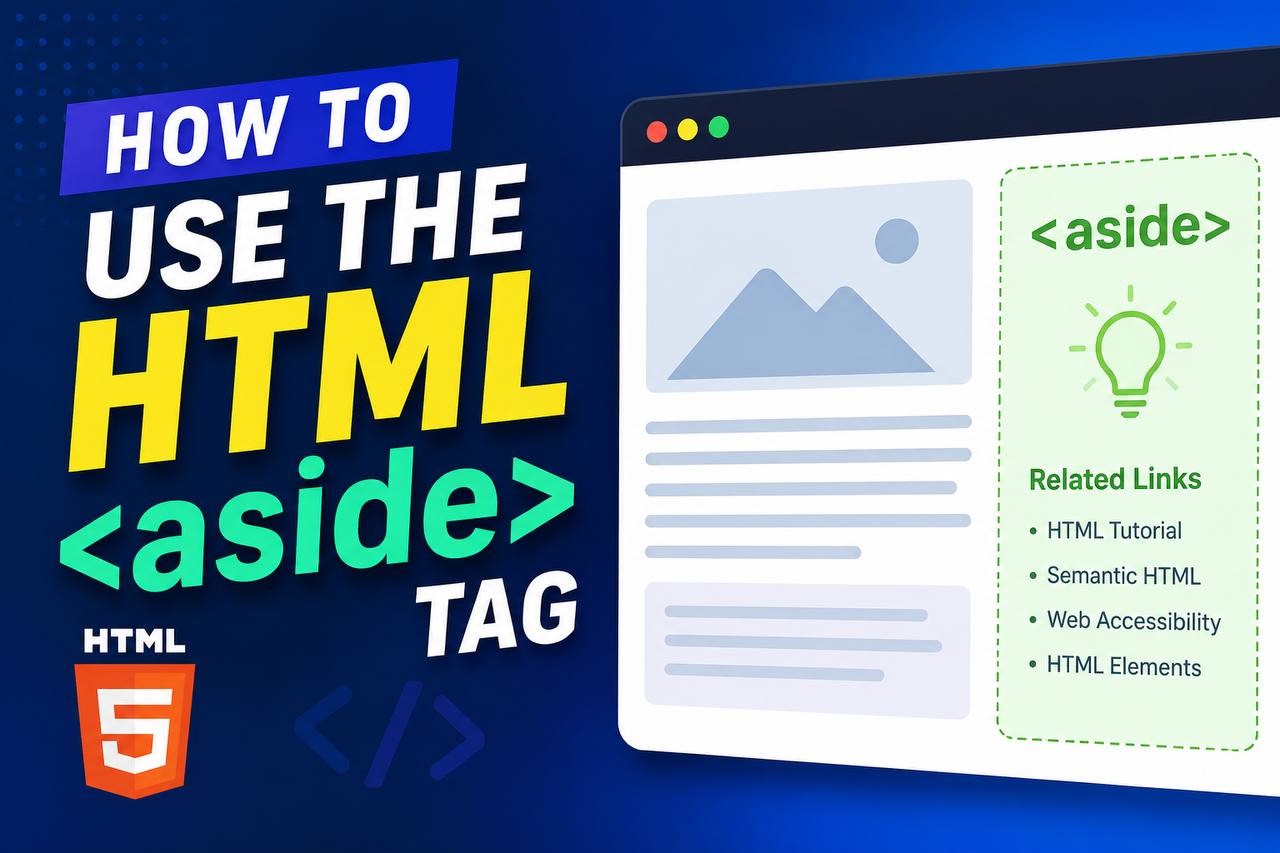
When building modern websites, organizing content properly is very important. HTML provides several semantic elements that help developers structure webpages clearly and professionally. One of those useful semantic elements is the <aside> tag.
The HTML <aside> element is commonly used for side content that is related to the main content but not part of the central focus of the page. Beginners often see the <aside> tag in tutorials but may not fully understand when or why to use it.
In this beginner-friendly guide, you will learn what the HTML <aside> tag is, what it does, where it should be used, common beginner mistakes, and how it improves webpage structure, accessibility, and readability.
This article focuses mainly on easy explanations with only a few simple examples so you can understand the concept clearly.
What is the HTML <aside> Tag?
The HTML <aside> tag is a semantic element used to contain content that is indirectly related to the main content of a webpage.
In simple words, the <aside> element holds extra information that supports the main content but is not the primary focus.
Think of it like side notes in a book.
For example, an <aside> section may contain:
- Related articles
- Advertisements
- Author biography
- Tips or notes
- Sidebar menus
- Popular posts
- Extra links
- Quotes
The content inside <aside> adds useful information without interrupting the main topic.
Simple Syntax of the <aside> Tag
<aside>
  <h2>Related Posts</h2>

  <p>Learn more about HTML semantic elements.</p>
</aside>
This creates a small side section containing related information.

Why the <aside> Tag is Important
Many beginners ask:
“Why not just use a <div> element?”
The answer is semantic meaning.
The <aside> element tells browsers and developers:
“This content is related to the main content but not part of the primary topic.”
Here are some important reasons why the <aside> tag matters.
1. Improves Webpage Structure
The <aside> element helps separate supporting content from main content.
This makes webpages cleaner and easier to understand.
Old method:
<div class="sidebar">Modern method:
<aside>
The semantic version is more meaningful.
2. Better Accessibility
Screen readers can identify sidebar or supporting content more easily when <aside> is used.
This improves navigation for visually impaired users.
3. Easier for Developers to Understand
When developers read the code, they can instantly recognize secondary content areas.
This improves teamwork and maintenance.
4. Better Semantic HTML Structure
The <aside> element helps create professional webpage organization using semantic HTML.
What Kind of Content Goes Inside <aside>?
The <aside> element usually contains supporting or secondary content.
Common examples include:
- Related links
- Sidebars
- Author information
- Advertisements
- Popular articles
- Tips and notes
- Quotes
- Extra resources
Example:
<aside>
  <h2>HTML Tips</h2>

  <p>Practice coding daily to improve faster.</p>
</aside>
This tip supports the main content but is not the main topic itself.
Where is the <aside> Tag Commonly Used?
The <aside> element appears in many parts of websites.
1. Blog Sidebars
This is one of the most common uses.
A blog sidebar may contain:
- Search bar
- Categories
- Recent posts
- Popular articles
Example:
<aside>
  <h2>Recent Posts</h2>

  <ul>
    <li>Learn HTML</li>
    <li>Understanding CSS</li>
  </ul>
</aside>
2. Related Articles
News websites often show related stories beside the main article.
Example:
<aside>
  <h2>Related Articles</h2>

  <p>How Semantic HTML Improves SEO</p>
</aside>
3. Author Information
Some blogs place author bios inside an <aside> element.
Example:
<aside>
  <h2>About the Author</h2>

  <p>John is a web developer and teacher.</p>
</aside>
4. Advertisements
Websites sometimes place ads inside side sections.
Example:
<aside>
  Advertisement Area
</aside>
Difference Between <aside> and <section>
Beginners sometimes confuse these elements.
Here is the difference.
<aside> | <section> |
|---|---|
| Contains supporting content | Contains important grouped content |
| Secondary information | Main content organization |
| Often appears as sidebars | Usually part of primary content |
Example of <section>:
<section>
  <h2>Our Services</h2>
</section>
This is part of the main content.
Example of <aside>:
<aside>
  <h2>Related Links</h2>
</aside>
This provides supporting information.
Difference Between <aside> and <div>
This is another common beginner question.
<aside> | <div> |
|---|---|
| Semantic element | Generic container |
| Has meaningful purpose | No special meaning |
| Used for secondary content | Used mainly for layout |
Use <aside> when the content supports the main topic.
Use <div> for design or layout containers.
Can You Use Multiple <aside> Elements?
Yes.
A webpage can contain multiple <aside> elements if needed.
Example:
<aside>
  <h2>Related Posts</h2>
</aside>

<aside>
  <h2>Popular Tutorials</h2>
</aside>
This is completely valid.
HTML5 and the <aside> Tag
The <aside> element became officially supported with HTML5.
Before HTML5, developers mostly used:
<div class="sidebar">Modern HTML uses:
<aside>
This creates clearer webpage structure.
Real-Life Example of <aside>
Imagine a blog article page.
The page contains:
- Main article
- Sidebar with recent posts
- Author profile
- Advertisement
The sidebar content can be placed inside <aside>.
Example:
<main>

<article>
  <h1>Learn HTML</h1>
</article>

<aside>
  <h2>Recent Tutorials</h2>
</aside>

</main>
The article is the primary content.
The aside contains supporting information.
Combining <aside> with Other Semantic Elements
The <aside> element works well with:
Example:
<article>

<h1>HTML Tutorial</h1>

<p>HTML structures webpages.</p>

<aside>
  <p>Tip: Practice daily.</p>
</aside>

</article>
The aside adds extra helpful information.
Browser Support for <aside>
The <aside> element works in all modern browsers including:
- Chrome
- Firefox
- Safari
- Microsoft Edge
- Opera
You can safely use it in modern websites.
Styling the <aside> Element with CSS
The <aside> element can be styled using CSS like any other HTML element.
Example:
<aside>
  <h2>Sidebar</h2>
</aside>
aside {
background-color: lightgray;
padding: 20px;
width: 250px;
}This creates a simple sidebar appearance.
Common Beginner Mistakes
Here are mistakes beginners often make when using <aside>.
1. Using <aside> for Main Content
The <aside> element is for supporting content only.
Do not place the primary article inside it.
2. Replacing Every <div> with <aside>
Not every sidebar-looking area needs an <aside> tag.
Use it only when the content is related but secondary.
3. Confusing <aside> with <section>
Remember:
<section>organizes important content<aside>contains supporting information
4. Overloading the Sidebar
Too much content inside an <aside> can make webpages cluttered.
Keep side content useful and organized.
Accessibility Benefits of <aside>
Accessibility tools use semantic HTML structure to help users navigate webpages.
Using <aside> properly helps:
- Identify secondary content
- Improve screen reader navigation
- Organize webpage structure better
Modern websites should always consider accessibility.
SEO Benefits of <aside>
The <aside> element itself does not directly improve rankings, but semantic structure helps search engines understand content relationships better.
Well-structured pages improve:
- Content organization
- Readability
- User experience
Semantic HTML supports better SEO practices overall.
Example of a Full Webpage Structure
Here is a beginner-friendly example using <aside> correctly.
<!DOCTYPE html>
<html>

<head>
  <title>Aside Example</title>
</head>

<body>

<header>
  <h1>My Blog</h1>
</header>

<main>

<article>
  <h2>How to Learn HTML</h2>

  <p>HTML is the foundation of web development.</p>
</article>

<aside>
  <h2>Related Tutorials</h2>

  <p>Learn CSS and JavaScript next.</p>
</aside>

</main>

<footer>
  Copyright 2026
</footer>

</body>
</html>
This example includes:
- Header
- Main article
- Sidebar content
- Footer
It follows modern semantic HTML structure.
Best Practices for Using <aside>
Here are some useful tips.
Use <aside> for Supporting Content
Only place secondary information inside the <aside> element.
Keep Side Content Relevant
The content should relate to the main topic.
Avoid Overusing <aside>
Too many sidebars can confuse users.
Combine with Semantic HTML
Use <aside> together with:
This creates professional webpage structure.
Think About User Experience
Supporting content should help users, not distract them.
Real-World Websites That Use <aside>
Many modern websites use <aside> elements including:
- Blogs
- News websites
- Online magazines
- Educational websites
Common sidebar features include:
- Popular posts
- Categories
- Ads
- Author details
Why Semantic HTML Matters
The <aside> element is part of semantic HTML.
Semantic HTML improves:
- Accessibility
- Readability
- SEO structure
- Website maintenance
- Professional coding practices
Examples of semantic elements include:
These elements help create organized and understandable webpages.
The HTML <aside> tag is one of the most useful semantic elements for organizing supporting content on modern websites. It helps separate secondary information from the primary content clearly and professionally.
Instead of relying only on generic <div> containers, using <aside> improves webpage structure, accessibility, readability, and semantic organization.
As a beginner, understanding how to use the <aside> element properly will help you build cleaner and more professional websites.
The more you practice using semantic HTML elements like <aside>, the easier it becomes to create organized, user-friendly, and modern webpages.