If you are learning web development, you will quickly come across three important technologies: HTML, CSS, and JavaScript. Each one has a different job, but CSS is the technology responsible for making a webpage look attractive, organized, and comfortable to use.
HTML provides the structure of a webpage. CSS controls how that structure looks.
For example, HTML can tell the browser that a page contains a heading, paragraph, image, button, and navigation menu. CSS can then decide the colors, spacing, font sizes, backgrounds, borders, positions, and other visual details of those elements.
Without CSS, most webpages would look very plain. They would still contain useful information, but they would not have the polished appearance that people expect from modern websites.
The good news is that CSS is not something you need to understand all at once. You can learn it gradually, starting with simple properties and then moving toward layouts, responsive design, animations, and more advanced techniques.
This guide explains what CSS is, how it works, why it is important, and how beginners can start using it in their own practice projects.
What Does CSS Stand For?
CSS stands for Cascading Style Sheets.
The word “style” gives you an important clue about what CSS does.
CSS is used to control the presentation and appearance of HTML elements.
For example, you can use CSS to tell the browser:
- Make this heading blue.
- Make this button larger.
- Add space around this paragraph.
- Give this section a background color.
- Place these cards next to each other.
- Make the page work properly on a phone.
- Add a hover effect to a button.
CSS is therefore one of the main technologies used to design websites.
What Does CSS Actually Do?
Imagine you are building a house.
HTML would be similar to creating the structure of the house. It defines things such as rooms, doors, windows, and other parts.
CSS would be similar to decorating and arranging that house.
It can determine:
- Wall colors
- Furniture placement
- Room spacing
- Text appearance
- Decorative elements
Web development works in a similar way.
HTML creates the structure, while CSS controls much of the visual presentation.
For example, HTML might create a heading that says:
Welcome to My Website
CSS can make that heading larger, change its color, center it, and add space around it.
Why Is CSS Important?
CSS is important because users do not only care about whether a webpage contains information. They also need to be able to read and interact with that information comfortably.
A well-designed page can make content easier to understand.
CSS helps developers create:
- Clean layouts
- Attractive buttons
- Readable text
- Responsive websites
- Navigation menus
- Cards
- Forms
- Sidebars
- Headers and footers
- Interactive effects
It also allows developers to maintain a consistent visual design throughout a website.
Instead of manually changing every HTML element, you can create CSS rules that apply the same style to many elements.
HTML vs CSS
One of the first things beginners should understand is the difference between HTML and CSS.
HTML creates the content and structure.
CSS controls the presentation and appearance.
For example, HTML can create a button.
CSS can then determine:
- The button’s color
- Width
- Height
- Text size
- Border
- Spacing
- Hover appearance
Think of HTML as the basic building structure and CSS as the design layer placed on top of it.
Neither technology completely replaces the other. They are normally used together.
How Does CSS Work?
CSS works by selecting HTML elements and applying styles to them.
A CSS rule normally contains three important parts:
- A selector
- A property
- A value
For example, imagine you want to make all headings blue.
You would select the heading element and tell the browser which property to change and what value to use.
The browser reads that instruction and applies the styling to the matching HTML element.
You do not need to memorize every CSS property immediately. In fact, beginners are better off understanding the basic idea first and then learning properties as they build projects.
Your First CSS Example
Let’s look at a small example.
The following page contains a heading, a paragraph, and a button. CSS is then used to give the page a simple design.
<!DOCTYPE html>
<html>
<head>
    <title>My First CSS Page</title>

    <style>
        body {
            font-family: Arial, sans-serif;
            background: #f4f4f4;
            text-align: center;
            padding: 40px;
        }

        h1 {
            color: #333;
        }

        p {
            color: #666;
        }

        button {
            background: #222;
            color: white;
            padding: 12px 20px;
            border: none;
            border-radius: 6px;
        }
    </style>
</head>

<body>

    <h1>Welcome to My Website</h1>

    <p>This is my first webpage styled with CSS.</p>

    <button>Learn More</button>

</body>
</html>
There is quite a bit happening in this example, but you do not need to understand every line yet.
The HTML creates the heading, paragraph, and button.
The CSS changes their appearance.
The page background becomes light, the heading receives a darker color, the paragraph receives a softer color, and the button receives its own background, text color, spacing, and rounded corners.
This is the basic relationship between HTML and CSS.
![[Screenshot Here Showing the HTML + CSS Example and Its Browser Output]](https://kayleotech.com/wp-content/uploads/2026/09/Screen-Shot-2026-09-06-at-7.56.59-AM-1024x333.png "What Is CSS? A Complete Beginner's Guide")
Understanding the CSS in the Example
Let’s break down the main ideas without going too deeply into code.
The body selector targets the main body of the webpage.
The CSS inside it controls general page styling, such as the font, background, text alignment, and spacing.
The h1 selector targets the main heading.
The p selector targets the paragraph.
The button selector targets the button.
Each selector has a collection of CSS declarations that control how that element looks.
This simple idea forms the foundation of CSS.
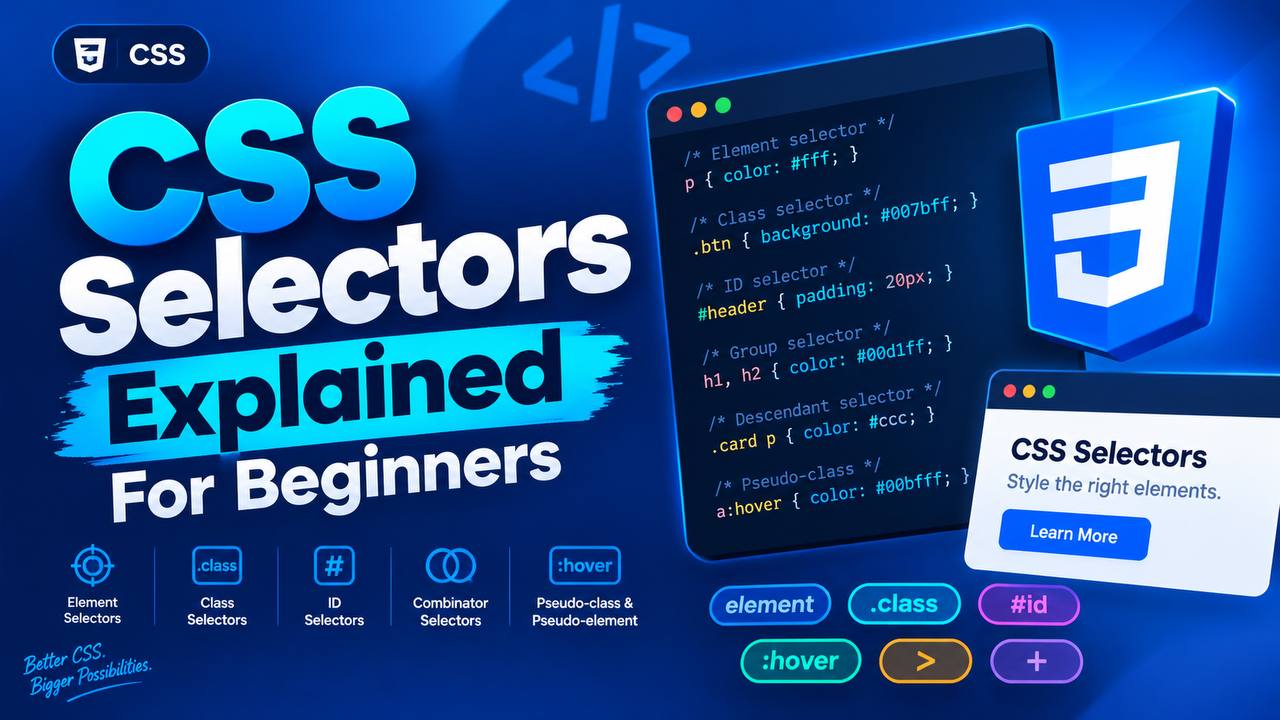
What Is a CSS Selector?
A selector tells CSS which HTML element should receive a style.
There are many types of selectors, but beginners usually start with element, class, and ID selectors.
For example, an element selector can target all paragraphs.
A class selector can target a group of elements that share the same class.
An ID selector can target a specific element.
Selectors become increasingly important as your webpages become larger because they allow you to control exactly which parts of a page should receive particular styles.
What Are CSS Properties?
A CSS property describes the part of an element’s appearance that you want to change.
There are hundreds of CSS properties, but you do not need to learn them all at once.
Some beginner-friendly properties include:
colorbackgroundfont-sizefont-familywidthheightmarginpaddingbordertext-align
For example, color controls text color, while font-size controls the size of text.
As you practice, these properties will become easier to remember.
What Are CSS Values?
A property needs a value that tells the browser what you want.
For example, a font size might use a value such as 20px.
A color might use a color name, hexadecimal value, RGB value, or another supported format.
The property tells the browser what to change, while the value tells it how you want it changed.
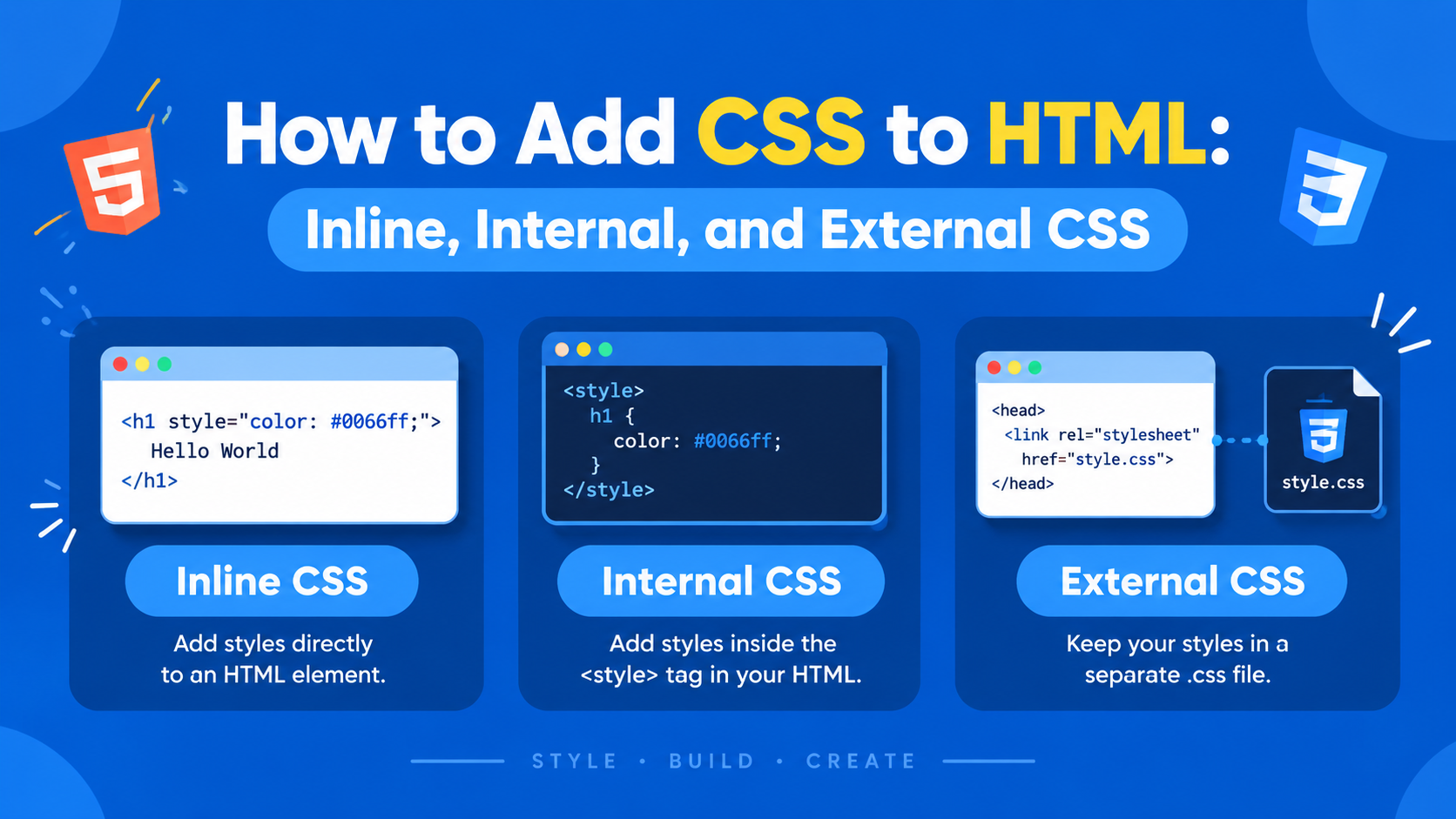
Three Ways to Add CSS to HTML
There are three common ways to add CSS to a webpage.
1. Inline CSS
Inline CSS is written directly inside an HTML element.
It can be useful for very small tests, but it is generally not the preferred approach for larger websites.
2. Internal CSS
Internal CSS is placed inside a <style> element in the HTML document.
This is useful for examples, small projects, and pages where the styling is specific to one document.
The example earlier in this article uses internal CSS.
3. External CSS
External CSS is placed in a separate .css file.
For example, you might have:
index.html
and:
style.css
The HTML file can then connect to the CSS file.
External CSS is commonly preferred for real websites because it keeps the structure and styling separate and makes styles easier to manage.
What Is the CSS Box Model?
The CSS box model is one of the most important concepts beginners need to learn.
You can think of every HTML element as a box.
That box has several parts:
- Content
- Padding
- Border
- Margin
Content is the actual material inside the element.
Padding creates space between the content and its border.
Border surrounds the element.
Margin creates space outside the element.
Understanding the box model makes it much easier to control spacing and layouts.
If you have ever wondered why an element appears too close to another element, the box model is usually part of the explanation.
What Is CSS Layout?
CSS is not only about colors and fonts.
It is also used to arrange elements on a webpage.
For example, you can use CSS to create:
- Two-column layouts
- Navigation bars
- Card grids
- Sidebars
- Centered content
- Flexible sections
Two particularly important CSS layout systems are Flexbox and CSS Grid.
Flexbox is commonly useful when arranging items in a row or column.
CSS Grid is useful for more structured two-dimensional layouts.
You do not need to learn both immediately. Start with simple layouts and gradually practice them.
What Is Responsive Design?
People visit websites using many different screen sizes.
Someone might open your website on a large desktop monitor while another visitor uses a small smartphone.
A responsive website adjusts its layout to provide a usable experience across different devices.
CSS plays a major role in responsive design.
You can use CSS techniques to change:
- Font sizes
- Element widths
- Column arrangements
- Navigation layouts
- Spacing
This allows one website to adapt to different screens rather than requiring completely separate designs.
CSS and Colors
Colors are one of the easiest parts of CSS for beginners to experiment with.
You can change the color of:
- Text
- Backgrounds
- Borders
- Buttons
- Icons
CSS supports several ways of describing colors.
You can use simple names such as red or blue, but professional designs often use hexadecimal, RGB, HSL, or other color formats.
Experimenting with colors is a good way to become comfortable with CSS because you can immediately see the result in your browser.
CSS and Typography
Typography refers to the way text is presented.
CSS gives you control over things such as:
- Font family
- Font size
- Font weight
- Line height
- Letter spacing
- Text alignment
Good typography is important because even a beautiful website can become difficult to use if the text is too small, crowded, or poorly spaced.
As a beginner, focus on making text comfortable to read rather than trying to use too many different fonts.
CSS Borders and Backgrounds
Borders and backgrounds can make simple HTML elements look much more polished.
For example, a plain paragraph can be placed inside a card-like section with:
- A background color
- A border
- Rounded corners
- Internal spacing
This is how simple HTML structures can gradually become attractive interface components.
CSS Hover Effects
CSS can also respond when a user interacts with an element.
One common example is a button that changes appearance when the mouse moves over it.
This is called a hover effect.
Hover effects can make websites feel more interactive without requiring JavaScript for simple visual changes.
For beginners, creating a button and giving it a simple hover effect is an excellent CSS practice exercise.
Is CSS a Programming Language?
CSS is generally described as a style sheet language, not a programming language.
This is because CSS does not work like JavaScript or languages such as Python.
CSS is designed primarily to describe how HTML elements should be presented.
You do not need programming experience to begin learning CSS.
If you already understand basic HTML, you can start learning CSS immediately.
Is CSS Difficult to Learn?
CSS is easy to start but can become more challenging as you move into advanced layouts.
The basic concepts are relatively straightforward:
- Select an element
- Choose a property
- Give it a value
- View the result
- Adjust the design
The challenge comes later when you start dealing with complex layouts, responsive designs, positioning, stacking, animations, and browser differences.
The best approach is therefore to learn CSS gradually.
Do not try to memorize hundreds of properties.
Instead, build small projects.
Beginner CSS Projects to Practice
One of the best ways to learn CSS is by creating small webpages.
You could start with:
1. Personal Profile Card
Create a profile card containing a name, image, description, and button.
Practice:
- Colors
- Padding
- Margin
- Borders
- Typography
2. Simple Navigation Bar
Create a horizontal navigation menu.
Practice:
- Flexbox
- Spacing
- Colors
- Hover effects
3. Product Card
Create a simple product card with an image, name, price, and button.
Practice:
- Box model
- Backgrounds
- Borders
- Buttons
4. Landing Page
Create a simple landing page containing a heading, description, button, and image.
Practice:
- Page layout
- Typography
- Spacing
- Responsive design
5. Login Form
Create a basic login interface.
Practice:
- Form styling
- Input fields
- Buttons
- Alignment
- Spacing
Small projects help you understand CSS much faster than simply reading lists of properties.
Common CSS Mistakes Beginners Make
When starting CSS, it is normal to make mistakes.
One common mistake is trying to learn too many properties at once.
Another is copying complicated designs without understanding how they work.
Beginners may also become frustrated when an element does not appear exactly where expected.
Instead of immediately adding more code, stop and check:
- Which element are you styling?
- Which selector are you using?
- Is another CSS rule overriding it?
- Does the element have the correct size?
- Are margin and padding affecting its position?
Learning to troubleshoot CSS is an important part of becoming comfortable with it.
HTML, CSS, and JavaScript Together
You will often hear HTML, CSS, and JavaScript described as the three major technologies of front-end web development.
A simple way to understand their roles is:
HTML = Structure
CSS = Presentation
JavaScript = Behavior
For example, imagine a button.
HTML creates the button.
CSS makes the button look good.
JavaScript can make something happen when the user clicks it.
The three technologies can work together to create complete interactive webpages.
What Should You Learn After Basic CSS?
Once you understand the fundamentals, you can gradually move into more advanced topics.
A useful learning path might look like this:
- CSS syntax
- Selectors
- Colors
- Fonts and typography
- Margin and padding
- Borders
- Width and height
- Box model
- Display
- Positioning
- Flexbox
- CSS Grid
- Responsive design
- Media queries
- Transitions
- Animations
- CSS variables
You do not have to master everything before building projects.
In fact, building projects while learning is one of the best ways to understand how the concepts work together.
Tips for Learning CSS Faster
The most useful advice for beginners is to practice consistently.
Start with a blank HTML file and try changing one thing at a time.
Change the background.
Then change the heading size.
Then add spacing.
Then style a button.
Then try arranging several elements.
Small experiments help you understand what each CSS rule actually does.
It is also helpful to inspect websites you like and look at how their elements are structured and styled. You should not simply copy everything; instead, use what you see as an opportunity to understand different design techniques.
Most importantly, do not become discouraged when your first layouts look imperfect. CSS takes practice.
CSS is the technology that allows developers to transform basic HTML structures into visually organized and responsive webpages.
It controls many aspects of a website’s appearance, including colors, fonts, spacing, borders, backgrounds, layouts, and responsive behavior.
The most important thing for beginners to understand is that CSS does not need to be learned in one sitting. Start with simple properties and gradually build your knowledge through practical projects.
Once you understand selectors, properties, values, spacing, the box model, and basic layouts, you will have a strong foundation for creating better webpages.
HTML gives your webpage its structure, CSS gives it its visual design, and JavaScript can later add behavior and interaction.
If you are beginning your web development journey, CSS is one of the most valuable skills to practice. Start small, experiment often, and build real projects as you learn. Over time, the concepts that initially seem confusing will become natural parts of your development workflow.